
Call for Papers | CPDS Special Issue
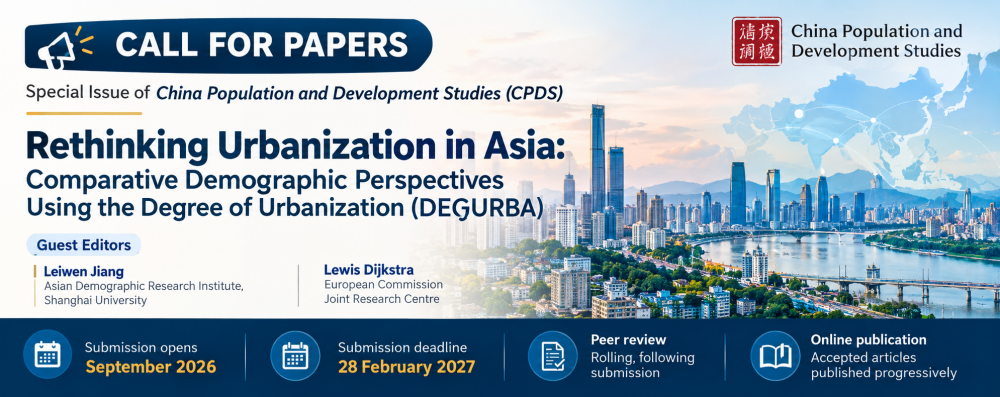
Call for Papers
Special Issue of China Population and Development Studies
Rethinking Urbanization in Asia: Comparative Demographic Perspectives Using the Degree of Urbanization (DEGURBA)
Guest Editors
Leiwen Jiang, Asian Demographic Research Institute, Shanghai University
Lewis Dijkstra, European Commission Joint Research Centre
Submission deadline: 28 February 2027
Manuscripts are reviewed on a rolling basis. Authors are encouraged to submit early.
Background and Rationale
Urbanization is one of the most profound demographic and spatial transformations shaping contemporary Asia. It influences migration and population redistribution, labor markets, population aging, fertility transitions, environmental sustainability, infrastructure demand, and regional inequality. Yet despite extensive research on urbanization, meaningful comparisons across Asian countries continue to face a fundamental challenge: the lack of a harmonized and internationally comparable definition of what constitutes an "urban" population.
Across Asia, national statistical systems define urban areas using highly heterogeneous criteria, often combining administrative status, population thresholds, density measures, economic structure, infrastructure, and governance arrangements. Consequently, reported urbanization levels may reflect differences in national statistical and administrative conventions as much as differences in underlying settlement patterns. This challenge is particularly important in Asia, where dense rural settlements, peri-urbanization, corridor-based development, metropolitan concentration, and dispersed settlement systems frequently blur conventional distinctions between rural and urban populations.
Recent methodological advances in the Degree of Urbanization (DEGURBA) framework provide an important opportunity to rethink urbanization from a comparative demographic perspective. Rather than relying solely on national administrative definitions, DEGURBA uses harmonized criteria based on population density, settlement size, and spatial contiguity to classify settlements into cities, towns and semi-dense areas, and rural areas. This approach substantially improves cross-national comparability and provides new opportunities to examine discrepancies between official urban classifications and the spatial realities of population settlement.
Against this background, China Population and Development Studies invites submissions to a Special Issue entitled "Rethinking Urbanization in Asia: Comparative Demographic Perspectives Using the Degree of Urbanization (DEGURBA)." The Special Issue seeks to bring together theoretically informed and empirically grounded studies from across Asia to develop a more comparable understanding of urbanization and its demographic and developmental consequences.
Objectives and Scope
The principal objective of the Special Issue is to advance comparative research on urbanization across Asia using harmonized analytical approaches. Particular attention will be given to the application of DEGURBA and related spatial-demographic methods to understand how national urban definitions differ from functionally defined settlement structures and what these differences mean for population and development research.
The Special Issue seeks not simply to produce alternative estimates of urbanization levels, but to examine how different forms of settlement and urban transformation interact with broader demographic processes, including migration, population redistribution, aging, fertility, regional inequality, environmental vulnerability, and socioeconomic development.
We welcome country studies, subnational studies, and comparative contributions addressing topics including:
- Applications of DEGURBA and other harmonized approaches to urban classification in Asian countries;
- Comparisons between national urban definitions and DEGURBA-based or functionally defined settlement classifications;
- Cross-national and subnational differences in urbanization levels, patterns, and trajectories;
- Metropolitan concentration, suburbanization, peri-urbanization, and the changing rural–urban continuum;
- Dense and dispersed settlement systems and forms of urbanization that may be underestimated by official classifications;
- Urban corridors, polycentric development, and emerging regional settlement systems;
- Urbanization, internal migration, and population redistribution;
- Urbanization, population aging, fertility change, and shrinking cities or regions;
- Urban settlement patterns, environmental pressures, climate vulnerability, and sustainability;
- Urbanization, regional inequality, infrastructure, and socioeconomic development;
- Implications of harmonized urban measurement for SDG 11 and broader sustainable development monitoring;
- Methodological innovations combining population grids, census data, geospatial information, remote sensing, and demographic data;
- New evidence and analytical opportunities associated with the UN World Urbanization Prospects 2025 Revision.
The primary geographical focus is Asia. Contributions representing different stages and forms of urban transition across East Asia, Southeast Asia, South Asia, and other Asian regions are particularly encouraged. Carefully selected non-Asian cases may also be considered where they provide useful comparative perspectives or contribute to a better understanding of the distinctiveness and diversity of Asian urbanization.
A Population and Development Perspective
A central objective of this Special Issue is to strengthen the connection between the measurement of urbanization and the analysis of population and development processes.
Contributors are therefore encouraged to move beyond the question of how much of a country's population is classified as urban and examine how alternative settlement classifications affect our understanding of demographic change. Questions of particular interest include: How does the spatial distribution of populations across cities, towns and semi-dense areas, and rural areas change when harmonized criteria are applied? Which forms of urbanization remain hidden or underestimated under existing national definitions? How do different settlement structures shape migration, aging, population redistribution, regional inequality, environmental vulnerability, and development outcomes?
Through these questions, the Special Issue aims to reposition urbanization not merely as a matter of spatial or statistical classification, but as a core population and development process shaping Asia's future.
Submission and Publication Schedule
| Submission opens | September 2026 |
| Submission deadline | 28 February 2027 |
| Peer review | Rolling, following submission |
| Online publication | Accepted articles published progressively |
| Special Issue publication | Accepted articles compiled into the complete Special Issue following completion of the editorial process |
Manuscripts will be processed on a rolling basis as they are received and will undergo the journal's standard peer-review procedures. Authors are therefore encouraged to submit early rather than wait until the closing date.
All submissions must be in English and should follow the submission guidelines of China Population and Development Studies. Complete manuscripts should be submitted through the CPDS online submission system. Please clearly indicate this special issue on the title page of your manuscript.
Accepted papers will be published online progressively following acceptance and completion of the journal's production process. All accepted contributions will subsequently be assembled into the complete Special Issue.
Submit Your Manuscript View Submission Guidelines
Background to the Special Issue
The Special Issue builds upon an ongoing international collaborative initiative on comparative urbanization research using the DEGURBA approach. The initiative emerged from an international training workshop at Shanghai University involving researchers from Asian countries and experts from the European Commission and partner institutions.
Researchers participating in this initiative have subsequently applied DEGURBA methods using country-specific census and spatial data. Preliminary findings from several country studies have already been presented at international academic meetings, demonstrating the potential of a common framework for identifying both shared and distinctive features of urbanization across Asian societies.
By bringing this emerging body of research together while also inviting contributions from the wider scholarly community, the Special Issue aims to develop a coherent comparative perspective on Asian urbanization and to stimulate further research at the intersection of population dynamics, spatial transformation, and sustainable development.
We welcome submissions that combine methodological rigor, substantive demographic analysis, comparative relevance, and clear implications for population and development policy.
Contact
For inquiries related to this special issue, please contact:
| Leiwen Jiang Shanghai University |
This email address is being protected from spambots. You need JavaScript enabled to view it. |
| Lewis Dijkstra European Commission Joint Research Centre |
This email address is being protected from spambots. You need JavaScript enabled to view it. |
| CPDS Editorial Office | This email address is being protected from spambots. You need JavaScript enabled to view it. |

APA Secretariat Office
Institute for Population and Social Research,
Mahidol University, Salaya Campus, Phutthamonthon,
Nakhon Pathom, 73170 Thailand  This email address is being protected from spambots. You need JavaScript enabled to view it.
Copyright © 2021 Asian Population Association
Visitor Info
Starting on April 1, 2021